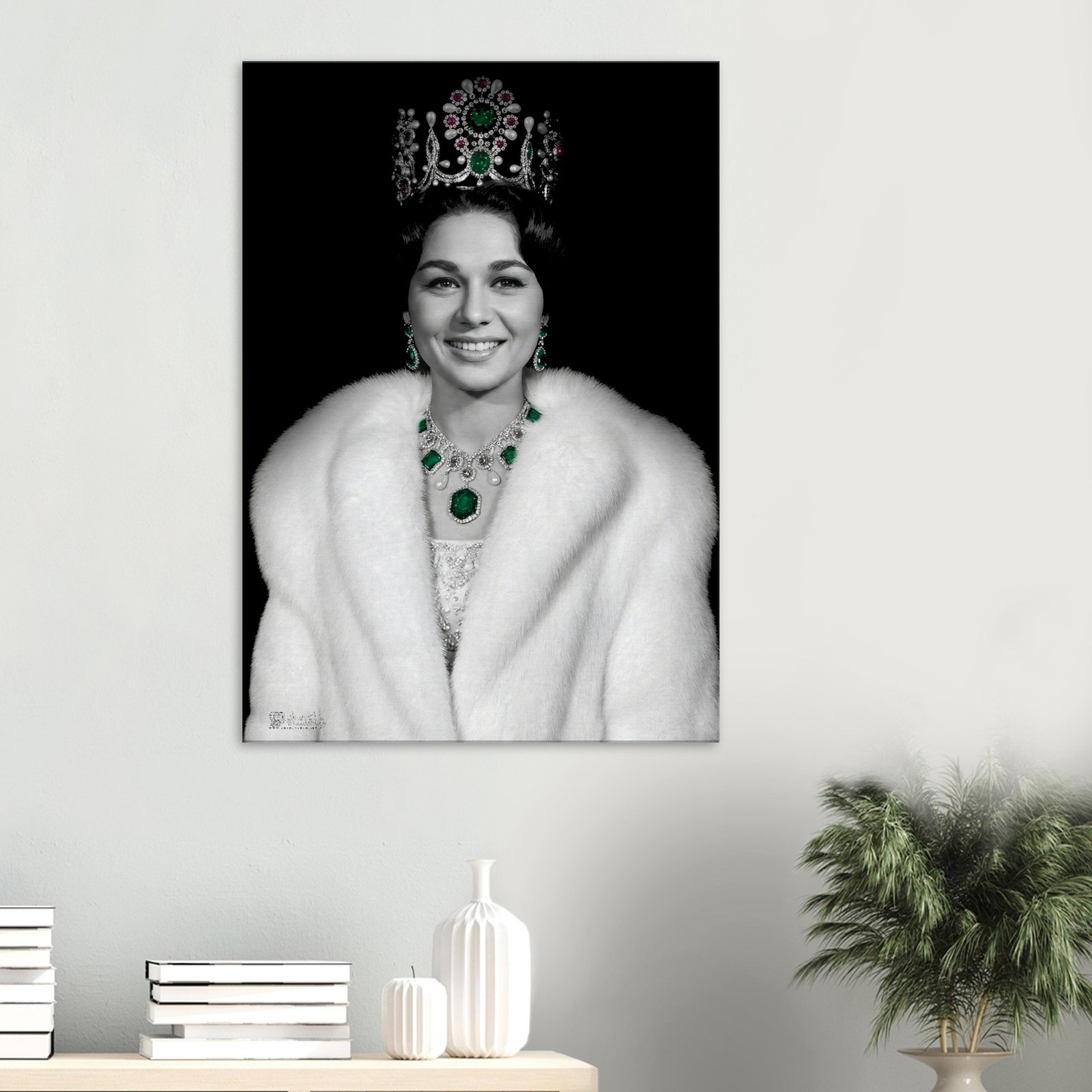
Farah Diba, known after her marriage as Farah Pahlavi, is Iran’s former empress consort and a patron of Iranian art and culture. Born in Tehran on 14 October 1938, she married Mohammad Reza Shah Pahlavi in 1959 and was crowned Shahbanou in 1967. Her story connects royal portraiture with museums, architecture and the preservation of Persian heritage.
This guide explores who Farah Diba was during the Pahlavi era, who she is today, and why her image continues to appear in Persian wall art. For the artwork itself, explore our Farah Pahlavi collection.
Who is Farah Diba?
Farah Diba and Farah Pahlavi are the same person: Diba is her family name, while Pahlavi is the name associated with her marriage and public life. She was the wife of Iran’s last shah, Mohammad Reza Pahlavi. She was an empress consort, rather than a reigning monarch in her own right. The title Shahbanou, also written Shahbanu, is commonly translated as “empress.”
Her official biography describes her childhood in Tehran, schooling at Italian and French institutions, and architectural studies in Paris. This background helps explain the importance of buildings, public spaces and visual culture in accounts of her later work. For a first-person institutional account, consult Farah Pahlavi’s official biography.
From architecture student to Shahbanou
Farah met the Shah during his visit to Paris in 1959. They married in Tehran on 21 December that year, as recorded by the official royal wedding account and the Académie des beaux-arts. They had four children: Reza, Farahnaz, Alireza and Leila.
On 26 October 1967, Farah was crowned Shahbanou. Coronation photographs gave her public image a distinctive visual language: a crown, ceremonial clothing and carefully arranged royal settings. These details are central to many portraits, but an artwork should not be treated as evidence of a particular ceremony unless its source and context have been established.
Explore Farah Pahlavi crown portraits
The two prints below offer different approaches to royal portraiture. One belongs to our historical-photography selection; the other is an artistic interpretation. Open each product to inspect the artwork and choose an available size.
-
Sale!
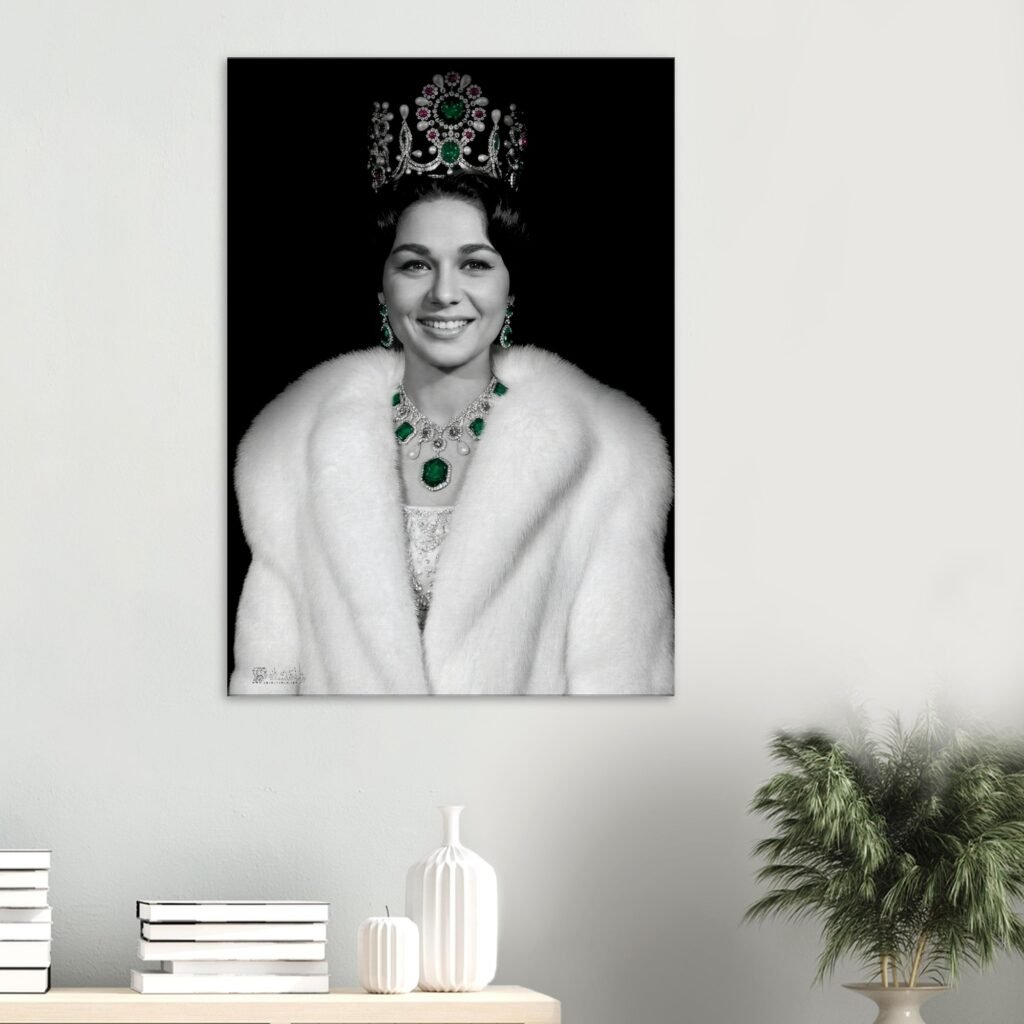
Shahbanu Farah Pahlavi Royal Crown Canvas Print – Persian Imperial Portrait Wall Art
From Original price was: $139.52.$55.81Current price is: $55.81. BY SHAHANSHAH ARTChoose Size This product has multiple variants. The options may be chosen on the product page -
Sale!
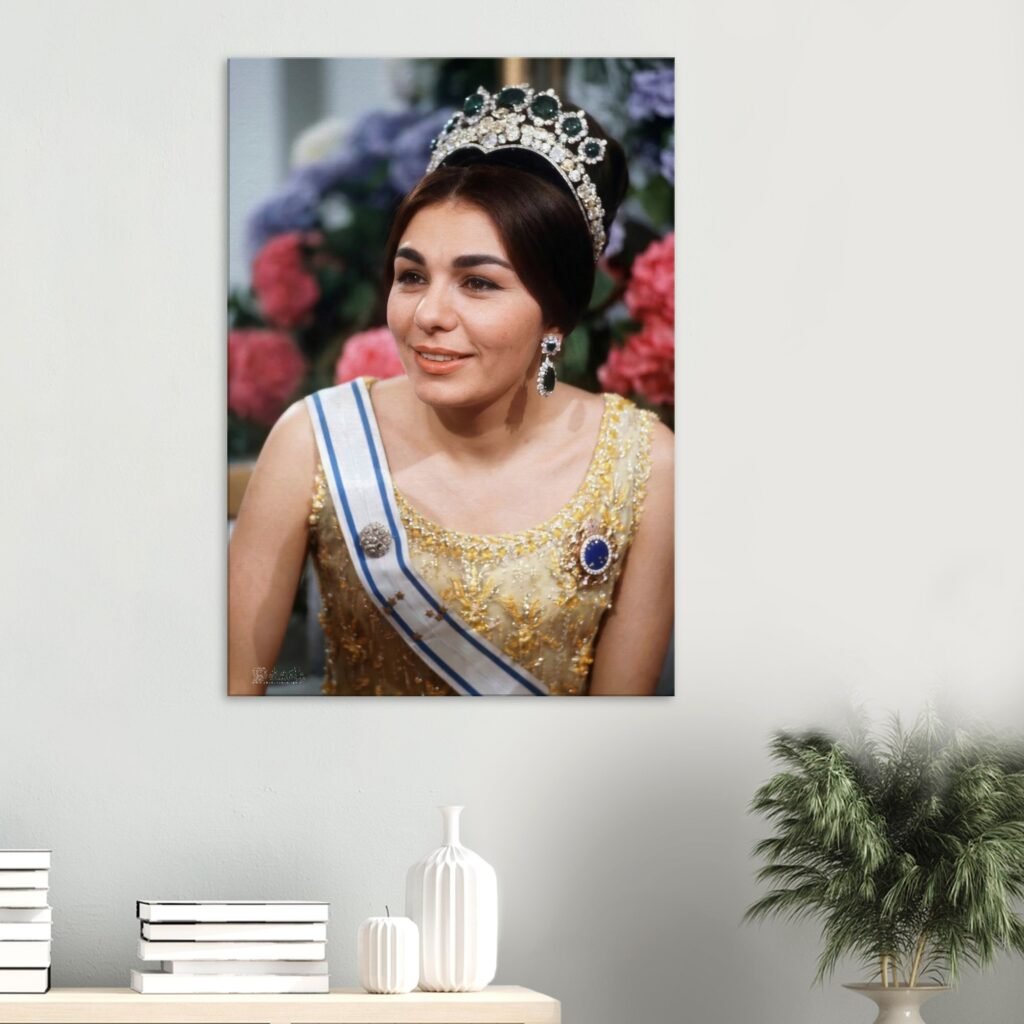
Empress Farah Pahlavi with the Royal Crown – Youthful Artistic Canvas Portrait
From Original price was: $139.52.$55.81Current price is: $55.81. BY SHAHANSHAH ARTChoose Size This product has multiple variants. The options may be chosen on the product page
View the full Farah Pahlavi collection →
Farah Pahlavi’s connection to art and cultural heritage
Farah’s cultural patronage extended beyond the commissioning of royal portraits. The Académie des beaux-arts describes her involvement in museums, education and the preservation of Iranian heritage. It also records her election as a foreign associate on 13 February 1974. This institutional recognition places her cultural work within a wider international setting.
The Tehran Museum of Contemporary Art is an important part of that story. It opened in 1977 and brought Iranian and international modern art into a major museum setting. In her 2014 interview with Bob Colacello, Farah discussed the museum, collecting and her concern for the survival of its collection after the revolution. Colacello also described the portrait she commissioned from Andy Warhol in 1976.
The Shahbanou Farah Pahlavi Foundation’s biography highlights another aspect of her work: support for traditional crafts, children’s libraries, historical buildings and cultural events. These projects connect the study of Farah’s public life with both modern art and older forms of Iranian visual expression.
For an art-focused reader, this is a useful distinction. A portrait records or reimagines a face; cultural patronage concerns the institutions and conditions in which art is made, preserved and encountered. Both belong in a discussion of her legacy. Neither should be used as a substitute for a broader, critical history of the Pahlavi period.
Who is Farah Pahlavi today?
Farah and Mohammad Reza Shah left Iran on 16 January 1979. The monarchy ended during the revolution that year, and the Shah died in Egypt in 1980. Farah’s present-day title refers to her former royal role; it does not mean she holds office in Iran today.
As of this article’s publication, her foundation describes her as living between France and the United States and continuing to support Iranian artists, writers and cultural causes. The foundation also presents educational, public-health and arts initiatives associated with her name. Readers looking for current activities should check those official updates, since public engagements and programmes change over time.
A different view: Farah and Mohammad Reza Shah
Portraits of the couple introduce another mood into a gallery wall. Compare the formal visual language of a crown portrait with a winter scene or a paired composition. Our product names describe the artwork being sold; no unverified photographer, exact location or date is attributed here.
-
Sale!
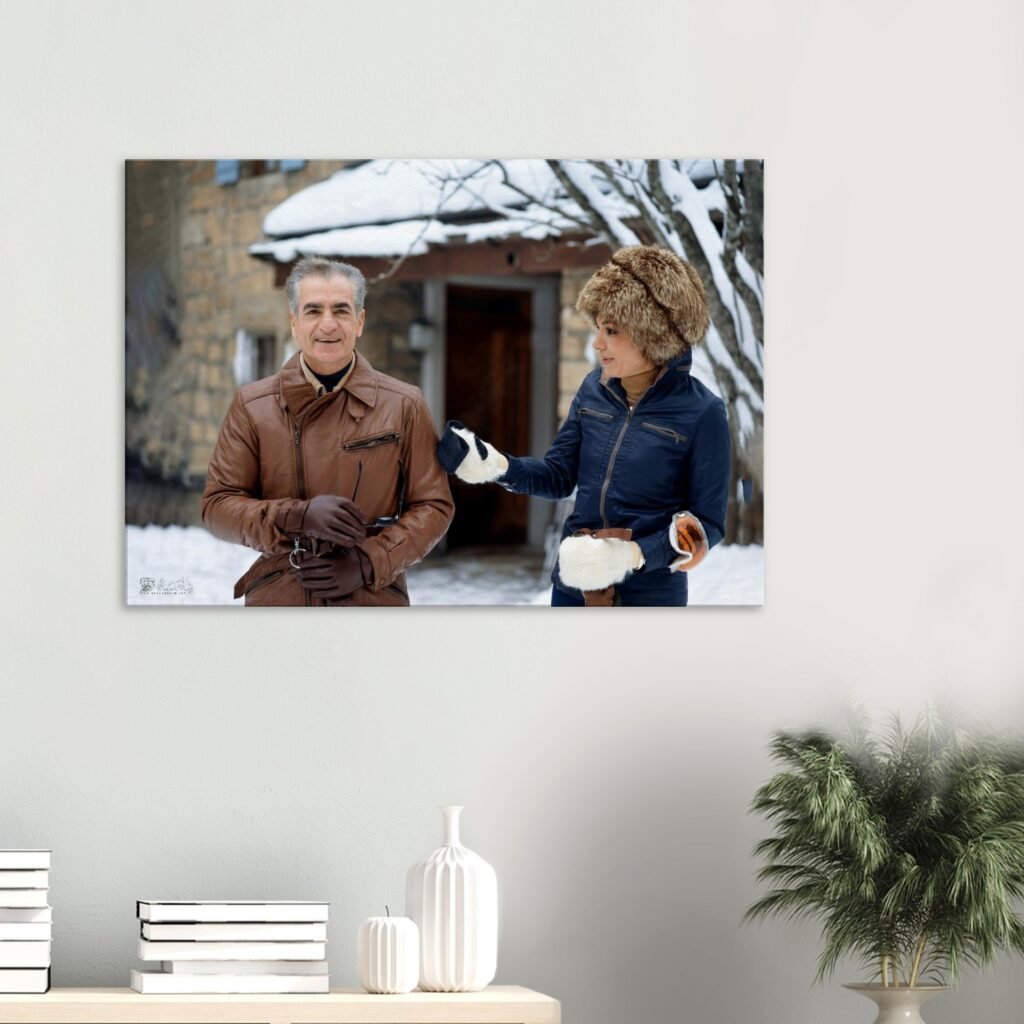
Historical Photography Canvas – Winter Vacations of Mohammad Reza Shah and Empress Farah
From Original price was: $139.51.$55.80Current price is: $55.80. BY SHAHANSHAH ARTChoose Size This product has multiple variants. The options may be chosen on the product page -
Sale!
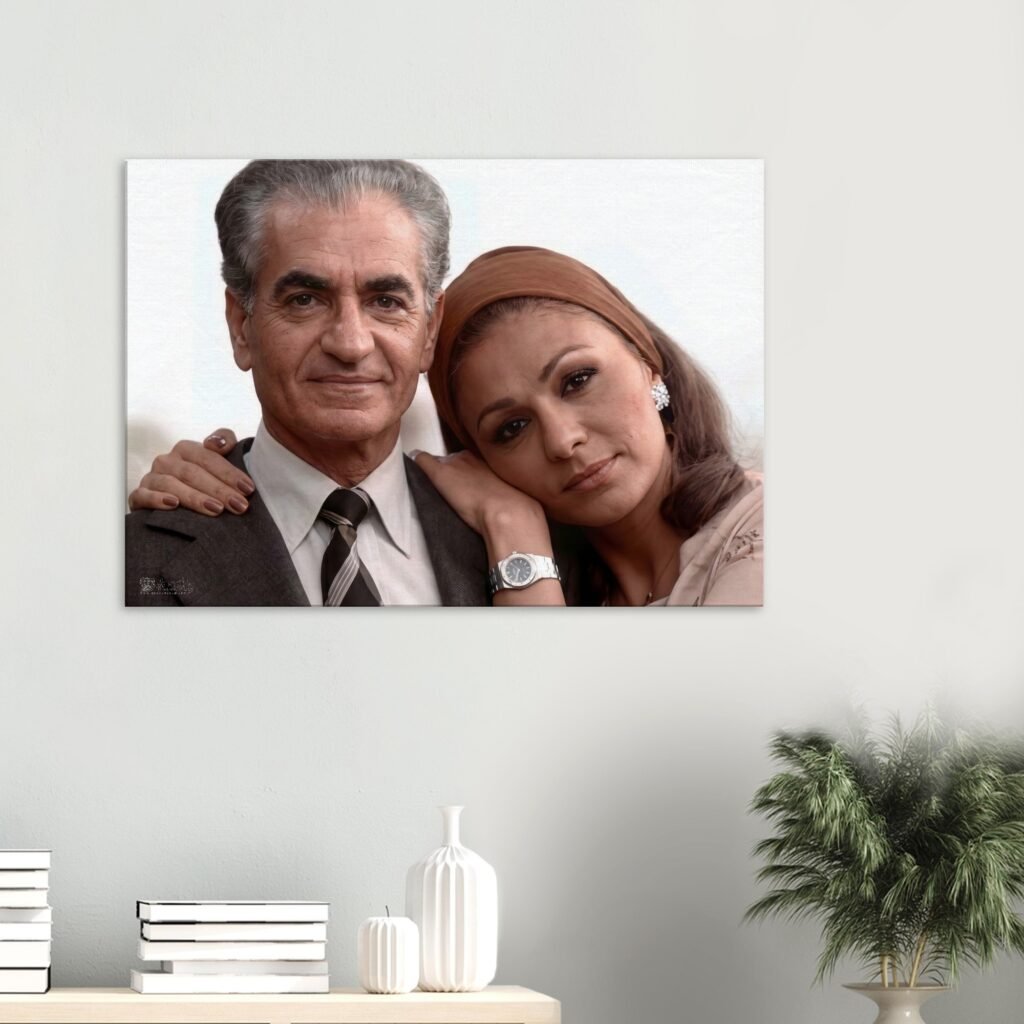
Mohammad Reza Shah Farah Pahlavi Romantic Portrait Canvas Wall Art – Persian Royal Decor
From Original price was: $139.51.$55.80Current price is: $55.80. BY SHAHANSHAH ARTChoose Size This product has multiple variants. The options may be chosen on the product page
Continue exploring the Pahlavi Dynasty collection or browse Historical Photography for related subjects.
Choosing Farah Diba wall art for your space
Begin with the image rather than the size. A ceremonial portrait can serve as a focal point, while a quieter photographic composition may work alongside family photographs, books or other Persian-inspired pieces. Compare the background, tonal contrast and direction of the sitter’s gaze before choosing neighbouring prints.
Next, measure the wall and consider the furniture below it. Use our Size & Care Guide to plan your display, then check the individual product’s available dimensions. Product images, prices and options can change; the linked product page provides the current details. For an overview of the visual approaches in the shop, visit Art Styles.
Frequently asked questions about Farah Diba
Are Farah Diba and Farah Pahlavi the same person?
Yes. Diba is her family name, and Farah Pahlavi is the name associated with her marriage to Mohammad Reza Shah and her subsequent public life.
When was Farah Pahlavi crowned?
She was crowned Shahbanou on 26 October 1967. She had married the Shah in December 1959.
Does she still hold a royal office in Iran?
No. Iran’s monarchy ended in 1979. References to Empress Farah or Shahbanou describe her former position or use a courtesy title.
Are the prints in this article original historical objects?
No. The linked products are contemporary printed wall art. Historical-photography prints and artistic interpretations are identified separately in their product listings. They are not original palace objects, original paintings or claims of royal endorsement.
Sources and editorial note
Prepared by Shahanshah Art using the official biography and wedding account, the Académie des beaux-arts profile, the Shahbanou Farah Pahlavi Foundation and the dated Interview magazine conversation linked above. Official and foundation accounts express their own institutional perspective. This article is an introduction to biography and visual culture, rather than a complete political history. Shahanshah Art is an independent retailer; the product links are commercial and do not imply affiliation with or endorsement by Farah Pahlavi.
Explore the collection: Farah Pahlavi wall art · Fine Art & Paintings · All prints