
Reza Shah Pahlavi: history, portraiture and Persian heritage.
Reza Shah Pahlavi (1878–1944) founded the Pahlavi dynasty and ruled Iran from 1925 to 1941. His reign reshaped the army, government, education and transport. It also concentrated power in the monarchy and restricted political independence. Understanding both sides of that record helps place his portraits within the history of modern Iran.
This guide introduces Reza Shah’s life and legacy, then looks at the military portraits and historical references found in our Reza Shah Pahlavi collection. The artworks are contemporary prints; they are not original royal objects or evidence of a particular historical event.
Who was Reza Shah Pahlavi?
Born in Alasht in Mazandaran in 1878, Reza Khan rose through the Iranian Cossack forces. The military intervention of 1921 brought him to the centre of national politics. He subsequently became minister of war and prime minister before the establishment of the Pahlavi monarchy in 1925.
The Encyclopaedia Iranica history of the Pahlavi army explains the connection between his military career and the new state. His coronation followed in 1926. “Reza Khan” and “Reza Shah” therefore refer to the same person at different stages of his public life.
Reza Shah and Mohammad Reza Shah: the difference
Reza Shah was the father of Mohammad Reza Shah Pahlavi. The father ruled from 1925 to 1941; the son succeeded him in 1941 and remained monarch until 1979. They appear in different generations of Pahlavi photographs, so checking the sitter’s name matters when choosing a portrait.
Farah Pahlavi was the wife of Mohammad Reza Shah, not Reza Shah. For the later generation and its cultural patronage, read our guide to Farah Diba’s life and cultural legacy. Browse the Pahlavi Dynasty collection to compare the period’s subjects.
State-building, education and modernisation
Reza Shah’s government pursued a more centralised state. A national army and an expanded bureaucracy helped extend authority beyond the capital. Administrative and legal changes strengthened institutions, while reducing the independence of competing centres of power. Iranica’s account of Pahlavi administration describes the tension between modern bureaucratic structures and personal royal authority.
Education formed another part of the programme. The University of Tehran was established in 1934, bringing together existing higher-education institutions and new faculties. The Iranica history of higher education explains the legislation, institutional planning and limitations of that development. These changes involved ministers, teachers and administrators as well as the monarch.
The Trans-Iranian Railway and a changing landscape
The Trans-Iranian Railway is one of the period’s most visible infrastructure projects. UNESCO’s World Heritage entry records construction from 1927 to 1938 and a route of 1,394 kilometres linking the Caspian Sea with the Persian Gulf. Its bridges and tunnels required international engineering collaboration across difficult terrain.
The railway entered the UNESCO World Heritage List in 2021, long after Reza Shah’s reign. It is useful to distinguish the original construction from its later heritage recognition. For a reader interested in visual culture, railways, uniforms and public buildings show how ideas of national development were communicated through the landscape and official imagery.
Reading Reza Shah’s military portraits
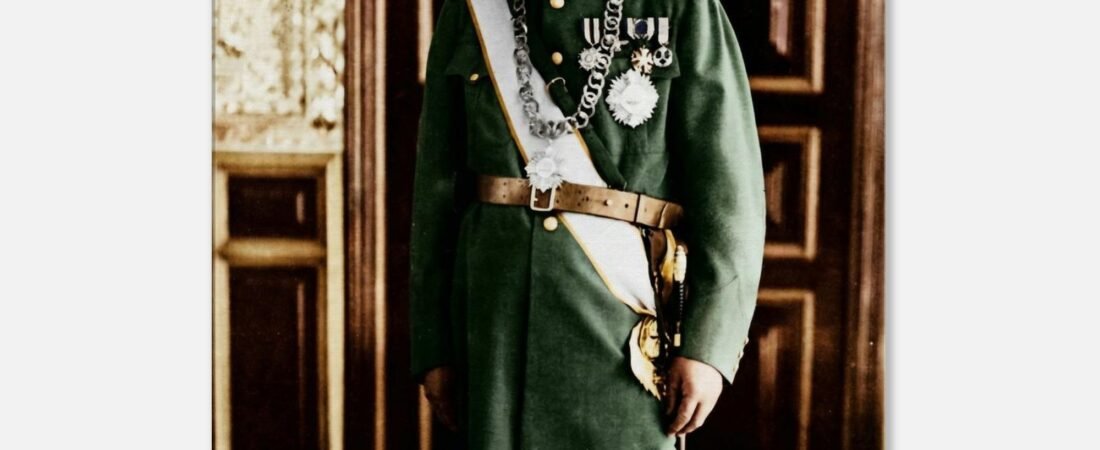
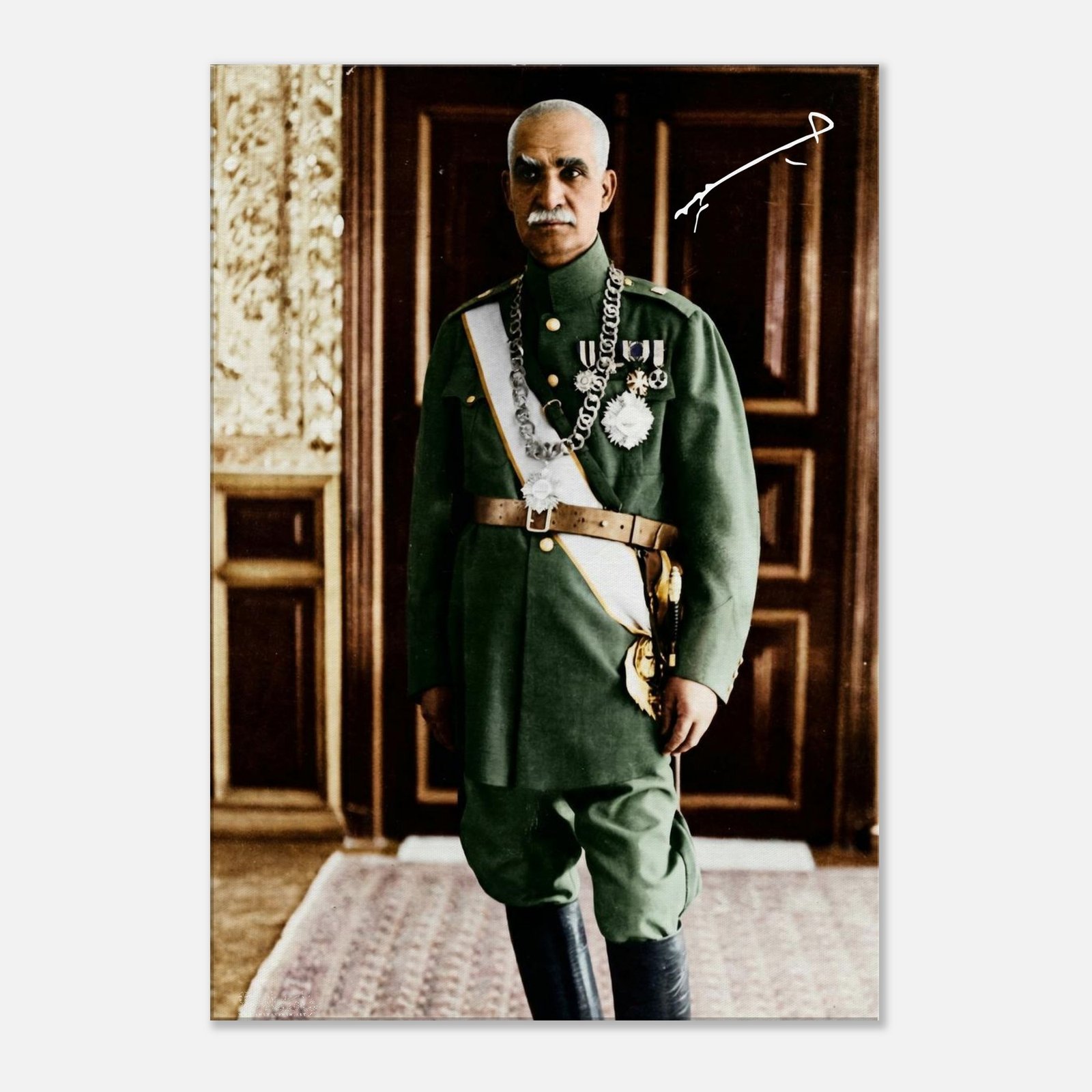
A formal portrait asks the viewer to notice posture, uniform, medals and the direction of the gaze. In Reza Shah imagery, these details often emphasise command and the connection between the army and the state. A seated portrait can feel composed and monumental; a closer view may focus attention on the face and expression.
The two prints below offer a starting point for comparing that visual language. Inspect each product’s images and available dimensions before selecting a size. Historical-photography products and graphic interpretations should be understood according to their individual descriptions.
-
Sale!
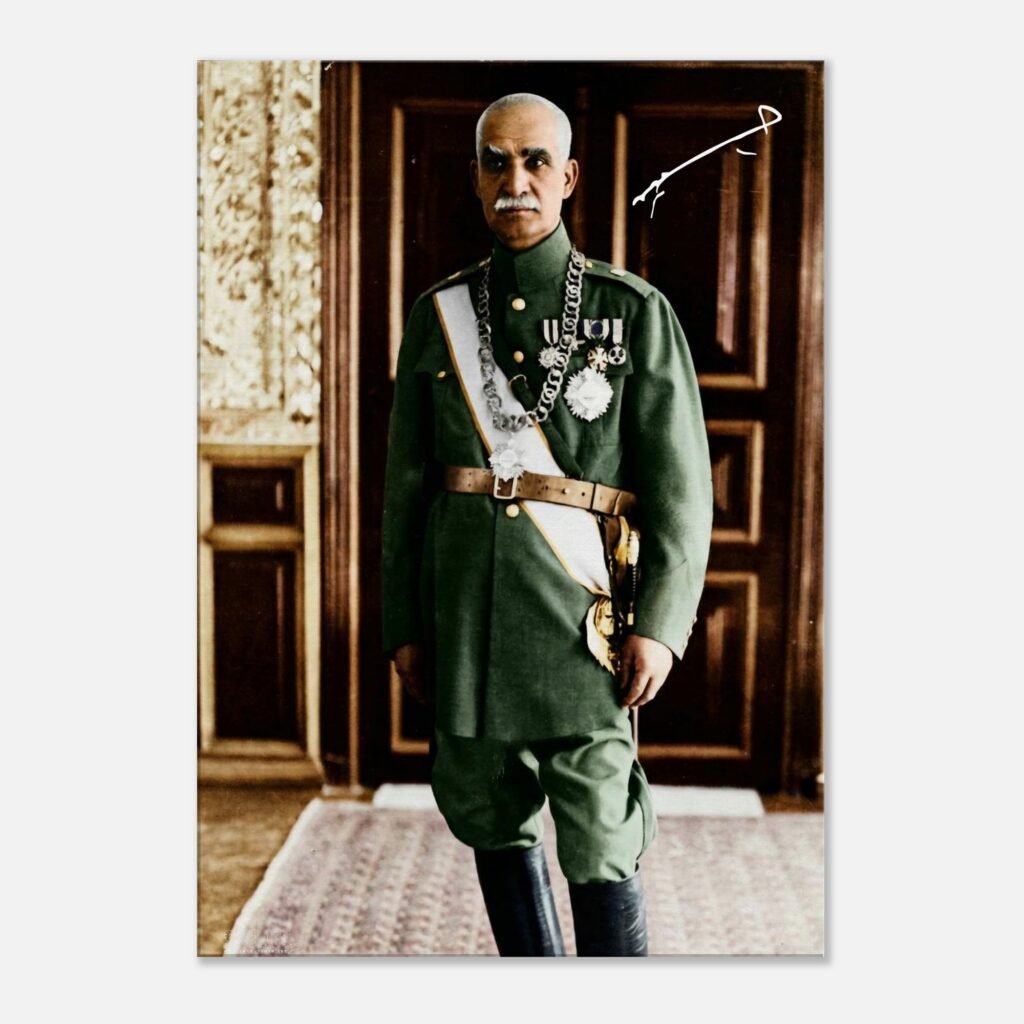
Reza Shah Pahlavi Canvas Print – Historic Persian Royal Portrait Wall Art
From Original price was: $139.51.$55.80Current price is: $55.80. BY SHAHANSHAH ARTChoose Size This product has multiple variants. The options may be chosen on the product page -
Sale!
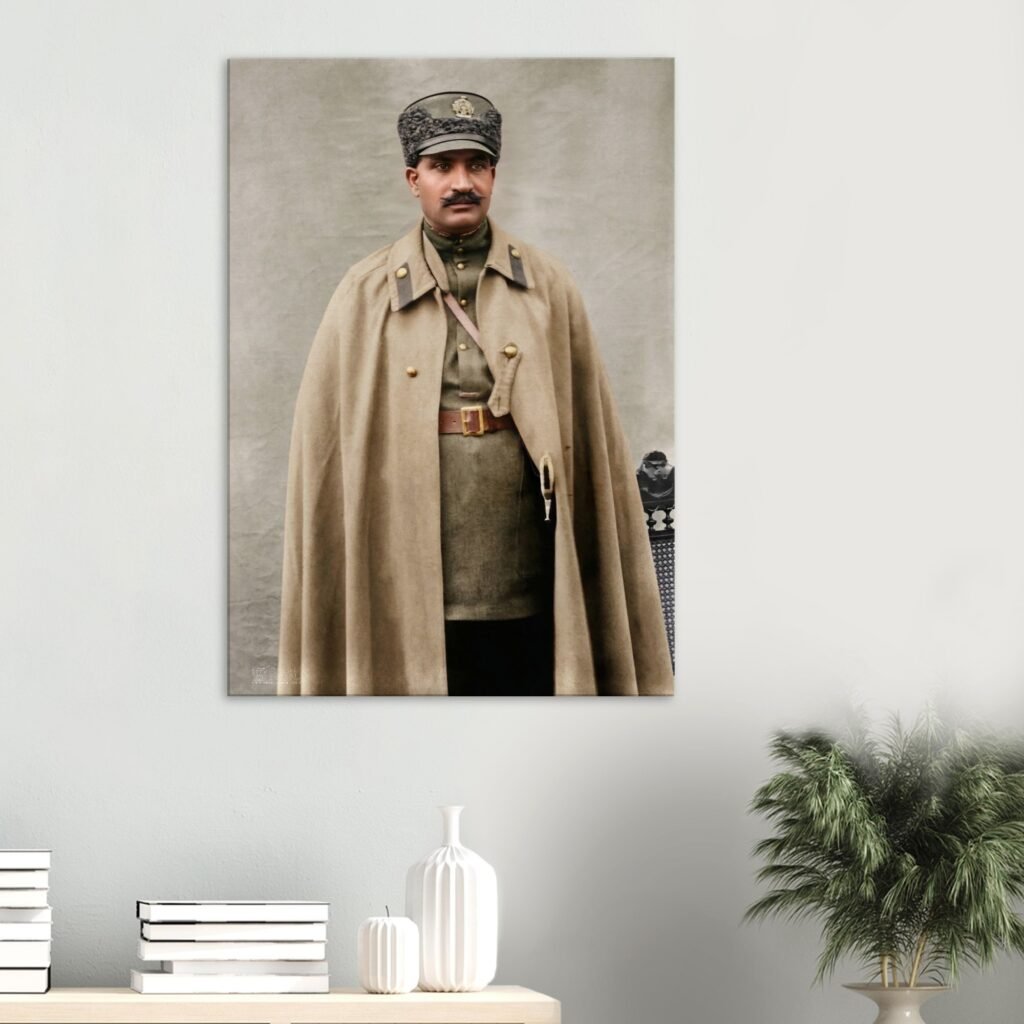
Commanding Portrait of Reza Shah Pahlavi in Military Uniform – Historical Canvas Wall Art
From Original price was: $139.52.$55.81Current price is: $55.81. BY SHAHANSHAH ARTChoose Size This product has multiple variants. The options may be chosen on the product page
Explore all Reza Shah Pahlavi wall art →
Heritage references and artistic interpretations
Some contemporary compositions place Reza Shah beside ancient Persian architecture or reinterpret his appearance through graphic forms. Such combinations can express a modern artist’s idea of historical continuity. They should not automatically be read as documentary photographs of the sitter at an ancient site.
Compare the products below with the formal portraits above. Look at how the background changes the mood and meaning of the image. For other approaches, explore Art Styles or Historical Photography.
-
Sale!
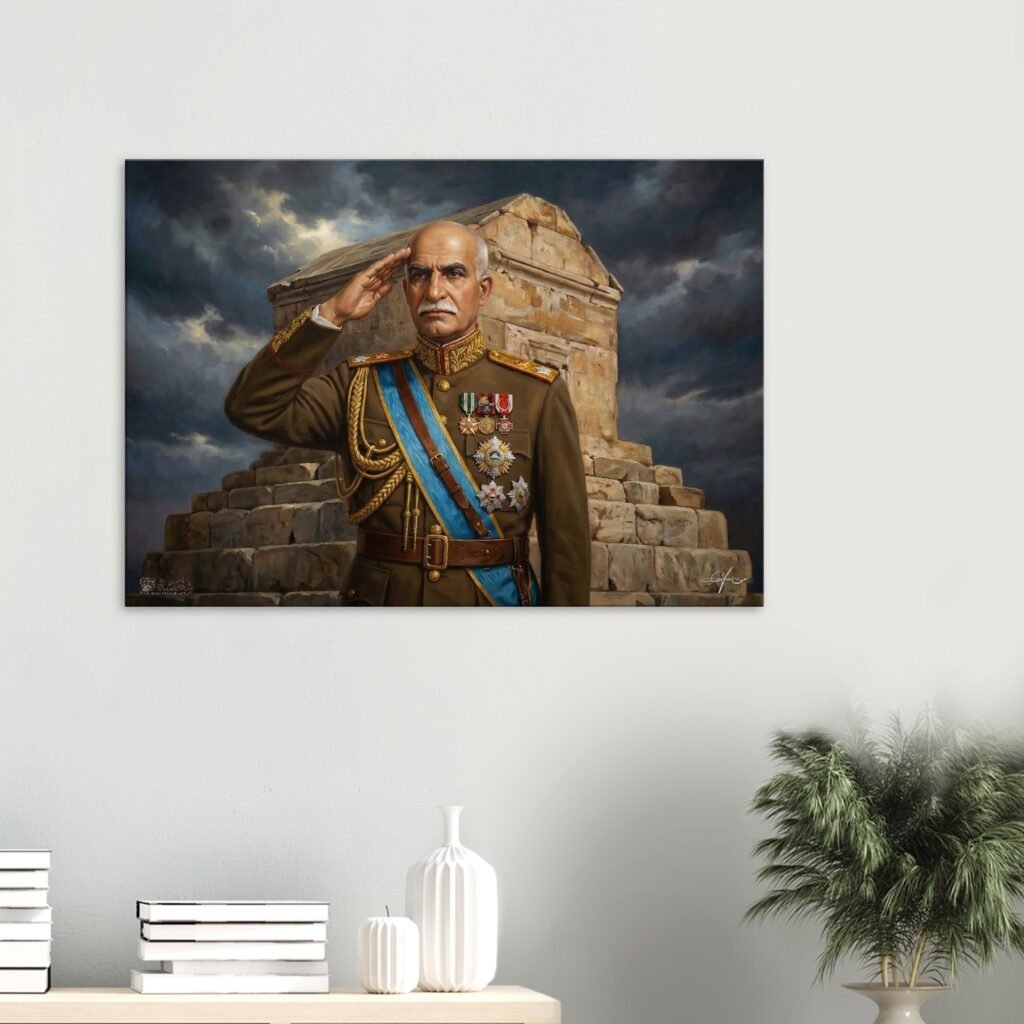
Reza Shah Pahlavi Portrait Canvas – Historic Persian Wall Art, Tomb of Cyrus Illustration
From Original price was: $139.51.$55.80Current price is: $55.80. BY SHAHANSHAH ARTChoose Size This product has multiple variants. The options may be chosen on the product page -
Sale!
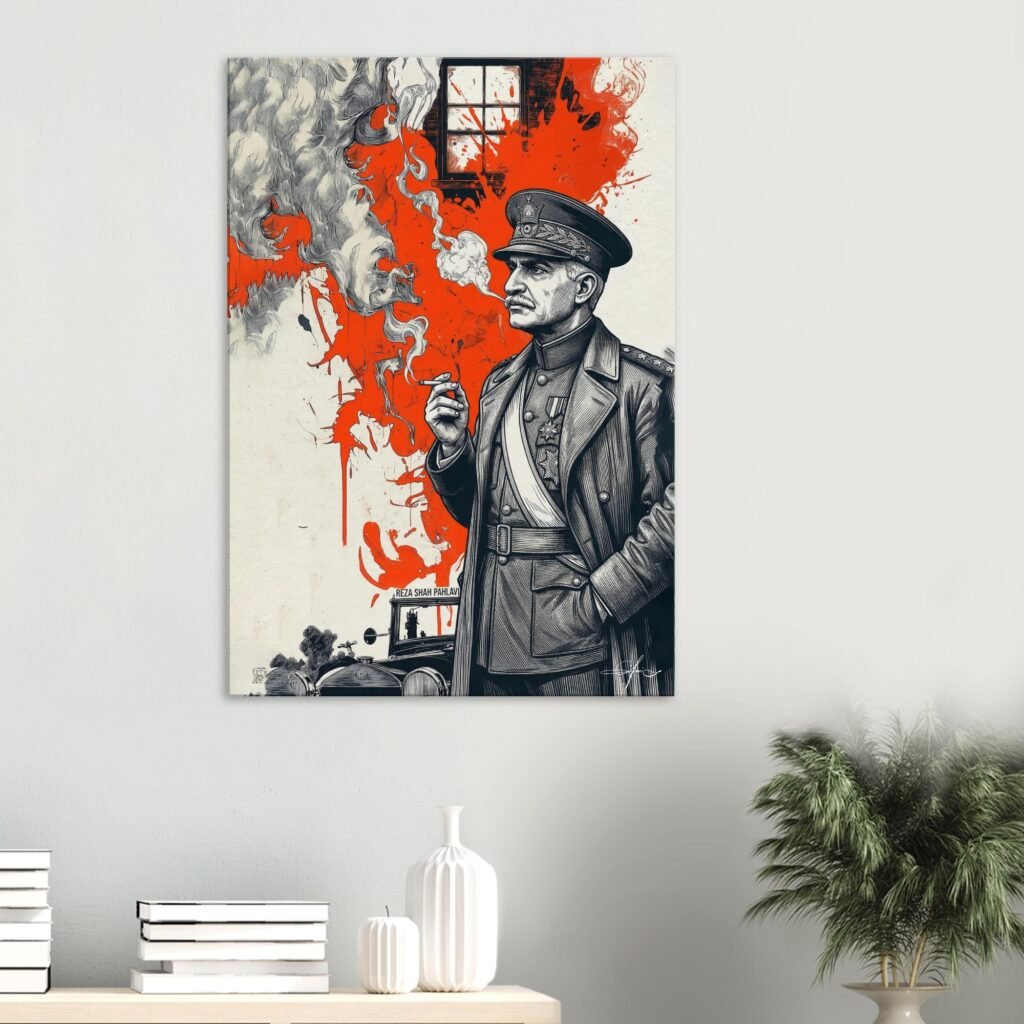
Graphic Art Canvas Wall Art – Portrait of Reza Shah Pahlavi in Military Attire
From Original price was: $139.52.$55.81Current price is: $55.81. BY SHAHANSHAH ARTChoose Size This product has multiple variants. The options may be chosen on the product page
Why his legacy remains debated
Modernisation did not mean political pluralism. Reza Shah’s rule combined institutional development with authoritarian government. Centralisation narrowed the space for independent political activity, and policies imposed from above could create conflict. A responsible account should recognise the expansion of state capacity while also considering coercion and its social consequences.
This distinction matters when displaying historical portraiture. An artwork can prompt interest in a period without serving as a complete judgment on its ruler. Reading beyond a product description allows the image to become the beginning of a historical conversation rather than the whole account.
Abdication, exile and death
British and Soviet forces invaded Iran in 1941 during the Second World War. Reza Shah abdicated, and Mohammad Reza Shah succeeded him. The former monarch went into exile and died in Johannesburg, South Africa, in 1944. The Iranica chronology of Iranian history records his death and the later return of his remains to Iran.
Choosing Reza Shah wall art for your space
Start with the portrait’s composition. A formal uniformed figure can become a room’s focal point, while a graphic interpretation may sit naturally beside architecture, books or other Persian-inspired pieces. Compare the image’s dark and light areas with your wall colour and neighbouring artwork.
Then measure the wall and furniture below it. Our Size & Care Guide helps with planning. Use each product page for current dimensions, prices and options; the cards inside this article display the shop’s live product information.
Frequently asked questions about Reza Shah
Was Reza Shah the founder of the Pahlavi dynasty?
Yes. He established the dynasty in 1925 and ruled until 1941. His son Mohammad Reza Shah succeeded him.
Was Reza Shah the same person as Mohammad Reza Shah?
No. They were father and son, and their reigns belong to different phases of twentieth-century Iranian history.
When was the Trans-Iranian Railway completed?
UNESCO dates its construction to 1927–1938. World Heritage inscription followed in 2021.
Are these original historical paintings or royal possessions?
No. The linked products are contemporary printed wall art. Product titles and descriptions distinguish photographic subjects from artistic interpretations.
Sources and editorial note
Prepared by Shahanshah Art from the linked Encyclopaedia Iranica articles and UNESCO World Heritage documentation. This is an introduction to biography and portraiture, not a comprehensive political history. The modern prints shown here are sold by Shahanshah Art; their inclusion does not imply affiliation with the Pahlavi family or official endorsement.
Continue exploring: Reza Shah Pahlavi · Pahlavi Dynasty · All prints.